
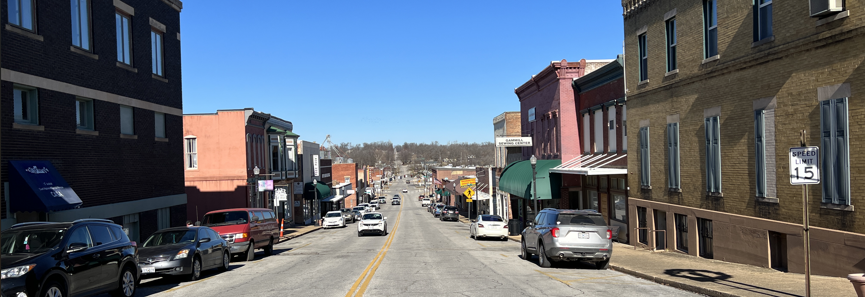
The Planning Commission is a nine-member board serving 4-year terms which serves as the city’s advisory body on land use and development. It develops and maintains the city’s comprehensive plan, helping guide decisions about growth, infrastructure, zoning, and redevelopment. The commission reviews proposed subdivisions and development plans, holds public meetings, and provides recommendations to the city council to support orderly, efficient, and community-focused development. Members must live within the city limits. The commission meets on the first Tuesday of every month at 5:30 p.m.
MEMBERS AND TERMS
- John Kenslow – Term expiring January 2027
- Terry Sanders – Term expiring January 2027
- Emma Block – Term expiring September 2028
- Brittany McDaniel – Term expiring December 2026
- Gus Ramseur – Term expiring January 2027
- Andy Stauffer – Term expiring September 2029
- Jayden Wiley – Term expiring September 2029
- Greg Collins – Term expiring April 2027
- Michael Topliff – Term expiring April 2027
GOVERNING LEGISLATION
The following words, terms and phrases, when used in this article, shall have the meanings ascribed to them in this section, except where the context clearly indicates a different meaning:
Street means a right-of-way, other than an alley, dedicated or otherwise established to the public use, usually affording the principal means of access to abutting property.
Subdivision means the division of any parcel of land shown as a unit, as part of a unit, or as contiguous units on the last preceding transfer of ownership thereof into two or more parcels, sites, or lots for the purpose, whether immediate or future, of transfer of ownership.
(Code 1976, § 24-1; Code 2002, § 66-31)
The city council shall adopt, amend and carry out a city plan and appoint a planning commission with the powers and duties set forth in this article.
(Code 1976, § 24-2; Code 2002, § 66-32)
The planning commission shall consist of nine members, including a member of the city council, selected by the city council annually at its first organizational meeting, the city engineer, six citizens appointed by the mayor and approved by the city council, and either the mayor or one additional citizen also appointed by the mayor and approved by the city council.
(Code 1976, § 24-3; Code 2002, § 66-33; Ord. No. 3821, § 2, 7-21-2003)
The term of each of the citizen members of the planning commission shall be for four years, and terms will be staggered.
(Code 1976, § 24-5; Code 2002, § 66-34)
All citizen members of the planning commission shall serve without compensation.
(Code 1976, § 24-6; Code 2002, § 66-35)
Any vacancy in the membership of the planning commission shall be filled for the unexpired term by appointment by the mayor with the approval of the city council.
(Code 1976, § 24-7; Code 2002, § 66-36)
The city council may remove any citizen member of the planning commission for cause, stated in writing and after public hearing.
(Code 1976, § 24-8; Code 2002, § 66-37)
The planning commission shall elect a chairperson and secretary from among the citizen members. The terms of the chairperson and secretary shall be for one year each, with eligibility for re-election.
(Code 1976, § 24-9; Code 2002, § 66-38)
The planning commission shall hold regular meetings and special meetings, as it may provide by rule, and shall adopt rules for the transaction of business and keep a record of its proceedings, which record shall be a public record.
(Code 1976, § 24-10; Code 2002, § 66-39)
All public officials shall, upon request, furnish to the planning commission, within a reasonable time, all available information it requires for its work.
(Code 1976, § 24-17; Code 2002, § 66-40)
The planning commission shall have all the powers necessary to enable it to perform its functions and promote municipal planning and shall perform such functions as provided by law.
(Code 1976, § 24-4; Code 2002, § 66-41)
The expenditures of the planning commission, exclusive of grants and gifts, shall be within the amounts appropriated for that purpose by the city council.
(Code 1976, § 24-12; Code 2002, § 66-42)
(a) The planning commission shall make and adopt a comprehensive plan for the physical development of the city.
(b) The comprehensive plan, with the accompanying maps, plats, charts and descriptive and explanatory matter, shall show the commission’s recommendations for the physical development and uses of land, and may include, among other things, the following:
(1) The general location, character and extent of streets and other public ways, grounds, places and spaces;
(2) The general location and extent of public utilities and terminals, whether publicly or privately owned;
(3) The acceptance, widening, removal, extension, relocation, narrowing, vacation, abandonment or change of use of any of the subjects stated in subsections (b)(1) and (2) of this section; and
(4) The general character, extent and layout of the replanning of blighted districts and slum areas.
(c) The commission shall also prepare a zoning plan for the regulation of the height, area, bulk, location and use of private, nonprofit and public structures and premises and of population density, but the adoption, enforcement and administration of the zoning plan shall conform to the provisions of RSMo 89.010—89.250.
(Code 1976, § 24-13; Code 2002, § 66-43)
In the preparation of the comprehensive plan, the planning commission shall make careful and comprehensive surveys and studies of the existing conditions and probable future growth of the city. The plan shall be made with the purpose of guiding and accomplishing a coordinated development of the city which will, in accordance with existing and future needs, best promote the general welfare, as well as efficiency and economy in the process of development.
(Code 1976, § 24-14; Code 2002, § 66-44)
The planning commission and its members and employees may enter upon any land to make examinations and surveys in the performance of its functions.
(Code 1976, § 24-15; Code 2002, § 66-45)
(a) The planning commission may adopt the comprehensive plan as a whole by a single resolution or, as the work of making the whole comprehensive plan progresses, may from time to time adopt a part thereof, any part to correspond generally with one or more of the functional subdivisions of the subject matter of the comprehensive plan.
(b) Before the adoption, amendment or extension of the comprehensive plan or any portion thereof, the commission shall hold at least one public hearing thereon, which may be adjourned from time to time. Fifteen days’ notice of the time and place of such hearing shall be published in at least one newspaper having general circulation within the city.
(c) The adoption of the comprehensive plan shall require a majority vote of the full membership of the planning commission. The resolution shall refer expressly to the maps, descriptive matter and other matters intended by the commission to form the whole or part of the comprehensive plan, and the action taken shall be recorded on the adopted comprehensive plan or part thereof by the identifying signature of the secretary of the commission and shall be filed in the office of the commission, identified properly by file number.
(d) A copy of the comprehensive plan or part thereof shall be certified to the city council and the city clerk, and a copy shall be recorded in the office of the county recorder of deeds.
(Code 1976, § 24-16; Code 2002, § 66-46)
Before the adoption of any subdivision regulations or any amendment thereof by the city council, a duly-advertised public hearing thereon may be held by the city council.
(Code 1976, § 24-18; Code 2002, § 66-47)
Sec. 32-40. – Approval of subdivision plat required after comprehensive plan adopted.
After the planning commission adopts a comprehensive plan which includes a major street plan, a certified copy of which has been filed in the office of the recorder of deeds of the county, no plat of a subdivision of land lying within the city shall be filed or recorded until it has been submitted to and a report and recommendation made thereon by the commission to the city council, and the city council has approved the plat as provided by law.
(Code 1976, § 24-23; Code 2002, § 66-48)